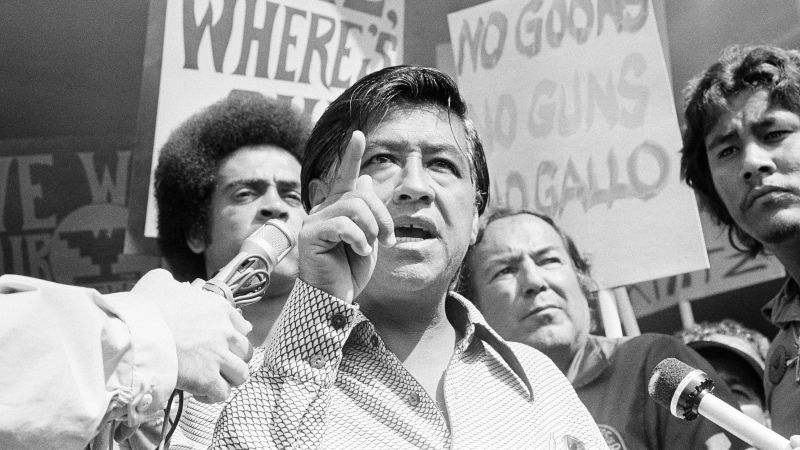
Cesar Chavez, a name synonymous with nonviolent activism and the tireless fight for farmworkers' rights, has long been revered as an American civil rights icon. His legacy, etched into state holidays and presidential offices, continues to inspire movements for social justice and labor equality. However, recent developments have cast a shadow over this celebrated figure, sparking Cesar Chavez news headlines and prompting states to reconsider their official tributes. Allegations of sexual abuse against the late labor leader, alongside a growing political controversy, are forcing a complex re-evaluation of how we remember and honor historical figures.
The Enduring Legacy of a Labor Icon
For decades, Cesar Chavez embodied the spirit of relentless advocacy for America's most vulnerable workers. Born into a farmworker family, Chavez understood firsthand the arduous conditions faced by those who toiled in the fields. His leadership of the United Farm Workers (UFW) in the 1960s ignited a movement that utilized powerful, nonviolent strategies such as marching on picket lines, orchestrating national grape boycotts, and undertaking prolonged fasts for justice. These actions galvanized support across the country, bringing unprecedented attention to the plight of farmworkers who endured grueling hours in scorching heat, exposure to dangerous pesticides, and lacked basic necessities like fair wages, access to bathrooms, and unemployment benefits.
Chavez's unwavering commitment profoundly transformed the agricultural landscape. Before his advocacy, farmworkers largely lacked legal protections. The UFW's efforts secured vital rights and improved working conditions that are now fundamental, demonstrating the power of collective action. His work garnered the attention and support of prominent figures like Robert F. Kennedy, Sr., who famously visited Chavez during one of his fasts in 1968, and Ethel Kennedy, who did the same in 1988. Even today, Chavez's influence resonates deeply within American politics; a bust of Cesar Chavez prominently sits in President Joe Biden's Oval Office, and his granddaughter, Julie Chavez Rodriguez, serves as Biden's campaign manager. The values Chavez lived by—resilience, a refusal to compromise on dreams, and a steadfast commitment to justice—continue to guide contemporary struggles for a humane immigration system, robust union rights, social justice for marginalized communities, and an economy where every American has a ladder of opportunity, not least through efforts to raise the minimum wage.
A Shadow Emerges: Allegations Challenge a Hero's Image
The long-standing narrative surrounding Cesar Chavez has recently encountered significant challenges. A stunning investigation brought forth deeply troubling allegations of sexual abuse against the late labor leader, who passed away in 1993. These claims have introduced a profound moral dilemma for institutions and individuals who have honored Chavez's memory, forcing a difficult reckoning with the complexities of historical figures.
The immediate impact of these allegations has been a noticeable shift in how some states approach Cesar Chavez Day, typically observed on March 31st, his birthday. Leaders in states like Arizona and California, both of which have long celebrated the holiday, have signaled a willingness to reconsider their tributes. Arizona Governor Katie Hobbs, a Democrat with a background as a social worker experienced in working with homeless youth and victims of domestic violence, has taken a decisive stance. Her office announced it would no longer recognize the holiday for Chavez, issuing a statement that articulated "deep concern by the troubling allegations" and emphasizing her commitment to victims of abuse. This move by Governor Hobbs underscores the gravity of the accusations and reflects a growing societal imperative to acknowledge and address serious misconduct, even when it involves revered historical personalities. The decision by state leaders to distance themselves from Chavez highlights the intense public scrutiny and ethical considerations that arise when a celebrated legacy is confronted with claims of personal wrongdoing.
Political Crosscurrents: The Chavez Family and 2024 Election Dynamics
Beyond the reevaluation of his legacy due to abuse claims, Cesar Chavez's name has also found itself at the center of a charged political debate, particularly in the lead-up to the 2024 presidential election. Robert F. Kennedy Jr., a candidate for president, has controversially exploited Chavez's image and name in his campaign advertising, leveraging the historical friendship between the Chavez and Kennedy families. This appropriation has been met with "shock and horror" by the Chavez family itself, including his sons, Paul and Fernando Chavez, and grandchildren Andres Chavez and Julie Chavez Rodriguez.
In a powerful rebuke, the Chavez family recently announced their unequivocal endorsement of President Joe Biden for re-election. This decision aligns them with dozens of Kennedy family members who have similarly denounced Robert F. Kennedy Jr.'s candidacy as a betrayal of his father's political legacy. The Chavez family's primary concern, as expressed by Fernando Chavez, is the fear that any support for Kennedy Jr. in a close contest could inadvertently aid Republican Donald Trump's return to the White House. Fernando Chavez also highlighted the devastating impact of COVID-19 on farmworkers, exacerbated by rampant disinformation about vaccine efficacy within Latino communities—a problem he implicitly links to the kind of skepticism promoted by Kennedy Jr. The Cesar Chavez Foundation, led by Andres Chavez, actively worked to vaccinate farmworkers, further underscoring the family's divergence from Kennedy Jr.'s stances. This endorsement not only underscores the deep political divisions of the current era but also serves as a poignant reminder of the family's dedication to the values and policy goals they believe Chavez himself would have championed. To learn more about this specific development, read our detailed report: Chavez Family Endorses Biden, Denounces RFK Jr. Campaign Use.
Navigating the Nuances: Remembering Chavez in a New Light
The current debates surrounding Cesar Chavez's legacy present a critical challenge for society: how do we reconcile the monumental achievements of a historical figure with serious allegations of personal misconduct? This isn't just about Cesar Chavez; it's a broader question about historical memory and the complex nature of heroism. While the claims of abuse demand serious consideration and cannot be dismissed, the indelible mark Chavez left on labor rights and social justice remains a significant part of American history.
For communities and institutions, navigating this nuanced territory requires a commitment to a more comprehensive and critical historical evaluation. Practical tips for doing so include:
- Separating the Deeds from the Person: It's possible to acknowledge the profound positive impact of Chavez's activism on farmworkers' lives and the broader civil rights movement, even while grappling with and condemning alleged personal failings.
- Fostering Open Dialogue: Encourage discussions that allow for the full spectrum of historical truth, including both laudable achievements and uncomfortable truths. This allows for a more mature understanding of historical figures.
- Focusing on the Values, Not Just the Icon: Chavez's core values—non-violence, perseverance, the fight for dignity and fair labor—are universally applicable. These principles can be championed independently of the person, allowing his ideals to continue inspiring positive change.
- Prioritizing Victims' Voices: In all discussions, the experiences and perspectives of alleged victims should be central and treated with respect and gravity.
As President Obama's 2014 proclamation reminded us, throughout his lifelong struggle, Cesar Chavez never forgot who he was fighting for. Even amidst these new challenges, his values continue to inspire today's fights for justice and union rights, immigration reform, and economic equality. The ongoing Cesar Chavez's Values: Inspiring Today's Fights for Justice & Union Rights remain a powerful beacon, guiding those who strive for a more equitable world.
The recent Cesar Chavez news reveals a pivotal moment in how America confronts its past and honors its heroes. The allegations of abuse against Cesar Chavez, coupled with the political friction surrounding his image, compel a necessary reassessment of his legacy. While his monumental contributions to farmworkers' rights and social justice are undeniable and continue to resonate in contemporary struggles for equality, the emerging information challenges a simplified narrative. As states reconsider their official recognitions, the public discourse reflects a growing expectation for honesty and accountability, even when dealing with figures of historical significance. Ultimately, the complex story of Cesar Chavez now serves as a powerful reminder that history is rarely black and white, and true understanding requires acknowledging the full, multifaceted humanity of its protagonists.